
Analysis.org Article
Nvidia, Broadcom, and AMD: Mapping the Next Blue Oceans in the AI
Super-Cycle
October 6, 2025 By Analysis.org
The AI super-cycle has thrust semiconductors into the center of global
strategy, turning companies like Nvidia, Broadcom, and AMD into
household names. All three compete in overlapping arenas - GPUs,
accelerators, networking, and custom silicon - but their paths forward
don't need to be confined to a zero-sum ''red ocean'' fight. Applying
the Blue Ocean Strategy lens, we can see how each player has already
sidestepped brutal head-to-head competition and where their next
uncontested waters may lie.
Strategy Canvas: Nvidia vs Broadcom vs AMD in the AI Super-Cycle
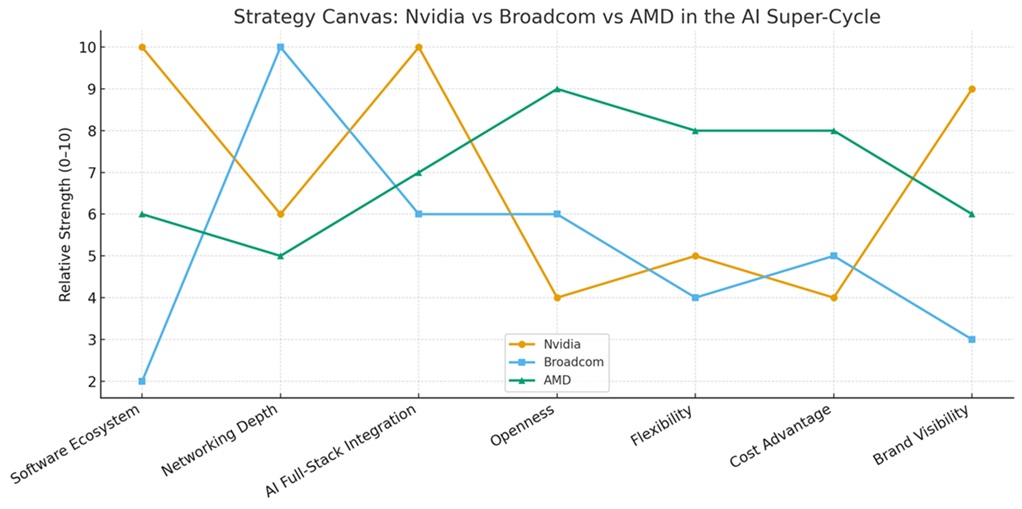
Here's the strategy canvas comparing Nvidia, Broadcom, and AMD.
It shows how their strengths diverge: Nvidia dominates on software
ecosystem and full-stack integration, Broadcom owns networking depth but
has weak brand visibility, and AMD positions itself as the flexible,
open, cost-friendly challenger. Each curve reflects a different blue
ocean they've carved within the AI market.
Nvidia: Expanding Beyond Chips Into the AI Operating System
Nvidia's genius blue ocean move was not just building faster GPUs, but
creating CUDA and the software ecosystem that made them indispensable to
developers. In the ''red ocean'' of pure silicon speed, AMD and Intel
could theoretically compete. But in the ''blue ocean'' of being the
operating system of AI, Nvidia became irreplaceable.
Eliminate: Dependency on CPU-centric compute; commoditized driver
layers.
Reduce: Traditional chip design cycles - Nvidia accelerated iteration.
Raise: Investment in developer ecosystems, frameworks, and AI-optimized
libraries.
Create: A full-stack AI platform (CUDA, cuDNN, TensorRT, DGX systems,
Omniverse, NIM microservices).
Looking ahead, Nvidia's next blue ocean is in agentic AI infrastructure.
It is positioning itself not just as a chipmaker but as the backbone of
AI agents - providing inference-optimized GPUs, networked AI factories,
and cloud-native inference APIs. A second blue ocean is in sovereign AI
stacks: offering countries turnkey AI platforms that bypass hyperscaler
dependence. The risk is regulatory scrutiny and over-concentration, but
Nvidia's culture of building software moats around hardware remains its
sharpest edge.
Broadcom: The Quiet Architect of AI Networks
Broadcom rarely gets the headlines Nvidia does, but its blue ocean play
has been just as clever: rather than compete directly in GPUs, it owns
the plumbing of the AI data center. Every hyperscaler building AI
clusters runs on Broadcom's networking chips, interconnects, and custom
ASICs.
Eliminate: The need for hyperscalers to buy networking from many small
vendors.
Reduce: Reliance on general-purpose CPUs for data movement.
Raise: Bandwidth, efficiency, and reliability of interconnects.
Create: A quasi-monopoly in AI networking (switches, SerDes, PCIe,
optical).
Broadcom's future blue oceans may emerge in AI-optimized networking
fabrics (making interconnects as critical as GPUs in system design),
quantum-era networking layers (where secure, ultra-low latency links
become essential), and custom ASICs for hyperscalers (where it acts as
the invisible foundry for Google, AWS, Meta). Its challenge is
visibility - Broadcom isn't a consumer brand - but its strength is the
opposite of Nvidia's: it thrives in being irreplaceable infrastructure
few outsiders even think about.
AMD: The Challenger Seeking Its Own Blue Ocean
AMD has long played catch-up, but its survival has always depended on
finding side doors. It undercut Intel in CPUs, then leveraged open
standards like ROCm to position against Nvidia. Its MI300 accelerators
show AMD is serious about AI - but if it simply mirrors Nvidia, it risks
drowning in the red ocean of GPU wars.
Eliminate: Proprietary lock-in wherever possible; AMD leans on open
ecosystems.
Reduce: Pricing complexity (offering hyperscalers more attractive
economics).
Raise: Flexibility - AMD chips are often more customizable.
Create: A credible second source for AI accelerators, which regulators
and hyperscalers need to keep Nvidia in check.
AMD's prospective blue oceans lie in hybrid architectures (combining
CPU, GPU, and memory coherently), edge AI accelerators (smaller,
power-efficient GPUs for inference outside data centers), and custom
co-design with hyperscalers (mirroring its semi-custom success with
PlayStation/Xbox). If AMD doubles down on being the ''open, flexible
alternative'' in AI hardware, it could cultivate a distinct demand curve
- especially if governments and cloud providers grow nervous about
Nvidia's dominance.
Strategy Canvas: Diverging Curves in the AI Market
Nvidia plots high on software ecosystem, AI full-stack integration, and
premium pricing, but lower on openness.
Broadcom scores highest on networking depth, low visibility in consumer
mindshare, and is nearly absent in developer ecosystems.
AMD emphasizes cost flexibility, open standards, and co-design
potential, but lags Nvidia on ecosystem lock-in.
Each diverges sharply from the ''red ocean'' of generic silicon vendors.
Nvidia created an AI OS, Broadcom a networking backbone, AMD a flexible
challenger role.
Future Blue Oceans: Probability-Weighted Outlook
Nvidia as AI OS & Agent Infrastructure (65% likely): Nvidia extends CUDA
into a global inference platform, bundling software + silicon.
Broadcom as AI Networking Monopolist (55% likely): AI data centers
become bottlenecked by interconnects, and Broadcom owns the rails.
AMD as Open, Flexible Alternative (40% likely): Wins share via
semi-custom, edge AI, and open ecosystems.
All three squeezed by sovereign demands & new entrants (25% likely):
Governments or open-hardware coalitions disrupt the current order.
What's striking is how different their blue oceans are: Nvidia sells an
AI future, Broadcom sells the rails, and AMD sells choice. Together,
they don't just compete - they define the terrain of the AI era. The
next five years will decide whether their oceans remain blue, or slowly
turn red as hyperscalers, governments, and startups look for ways to
break their dominance.
Filed Under: Briefing
------------
Copyright (C) All Rights Reserved - Damson Group.